8 minutes
Hardening Legacy PHP in Constrained Environments
The moment you realize that the roughest codebase you’ve seen is also one of the most valuable systems you’ve touched, things start to look a little different.
“Just modernize it” is not a security strategy if the main thing that matters is keeping core business processes running in a system that drives major revenue.
If you get called into an old PHP application, it can feel a bit like arriving at a crash site. After the initial shock, instead of judging, you start to think like an emergency responder: assess the scene, stabilize what matters most, and reduce the risk without making the situation worse.
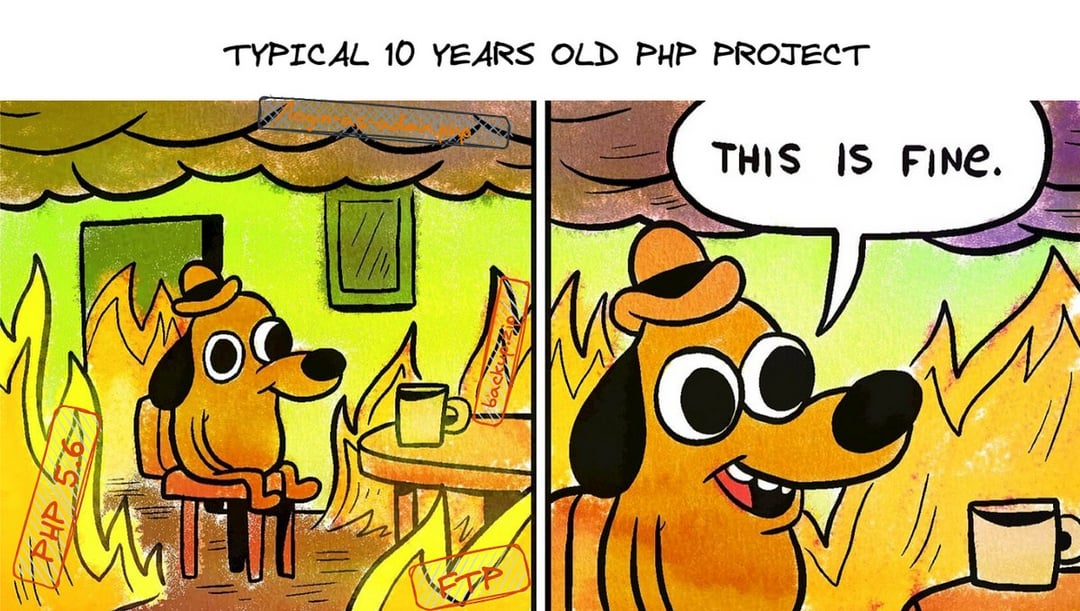
But usually, you do not get to pause the business, rebuild the stack, and come back in six months with clean infrastructure and a fresh deployment model. You have to reduce risk with the system you actually have, and you have to do it fast.
PHP is still the workhorse of the internet. The numbers reflect that. As of April 2026, W3Techs reports that PHP is used by 71.7% of all websites whose server-side language is known, and WooCommerce powers 49.6% of the e-commerce systems in its surveys. Exact revenue running through PHP is hard to measure from the outside, but it is obviously not a niche runtime surviving on hobby projects.
These systems process orders, send invoices, run customer portals, support internal operations, and keep businesses alive. They may look unimpressive from an architecture point of view, but they still matter commercially.
Maybe there is already a new solution in the works that is supposed to replace the application at hand. But maybe stakeholders have been through failed modernization attempts elsewhere before and do not trust timelines anymore. Or maybe there is nothing else planned, and rewriting a system that still generates major business value is simply out of the question.
Maybe some recent pentest results blew a few minds and raised compliance concerns.
The job is to improve, stabilize, and fix things up. Timeline? Yesterday. So the pressure is on from day one.
First: Define the environment honestly
A legacy PHP app on constrained infrastructure can mean many things, but usually we are talking about one or more of these, and often all of them:
- an application with direct business impact
- maintained by a small team or even a single developer
- built in the early 2000s to 2010s
- deployed into an environment that it outgrew at some point
- difficult to patch quickly without fear of breakage
- almost no appetite for major rewrites
A lot of these environments also come with very limited control and very limited resources:
- no root access
- no Docker or orchestration
- no ability to install anything on the system level
- no consistent or properly separated staging environment
- limited or missing centralized logs
- shared mail setup
- old cron jobs nobody wants to touch
- file permissions that grew organically over the years
- no control over subdomains or domain configuration
In those environments, threat modeling has to become more pragmatic.
The question is not: how would we build this securely, performantly, and maintainably?
The question is: given the system we actually have, what is most likely to go wrong next, what would have the biggest business impact, and how can we buy the most risk reduction without risking operations?
This sounds obvious, but “without risking operations” is easier said than done.
Just imagine a large PHP application written mostly in procedural code, with many entry points, years of accumulated integrations, and modules that gradually took on routing and orchestration responsibilities of their own. Nobody is completely sure what is still in use, by whom. Scheduled jobs manipulate the database, import and export data, and send mail, often all of it at once in a massive PHP file that grew over many years without much opportunity for cleanup. The surrounding server setup is locked down in all the places you would like control, but at the same time feels exposed to the public.
It is like working on a major highway bridge that cannot be closed, even though time, load, and years of improvised repairs have left it in a bad state.
Now is certainly not the moment to look for guidance in Clean Code. It is still useful to know what good looks like when refactoring, but right now that is not the priority.
Second: Set up some basic DevOps and tools
Before thinking about controls, I try to remove unnecessary friction from the development process.
Common examples:
- fragile deployment processes: direct file uploads into production
- chaotic dependencies: libraries copied manually into whichever directory needs them
- little observability: logs written inconsistently across the application and host
- version control is missing or incomplete, so deployment means manual reconciliation between environments
Quickest improvements:
- if the test environment is unreliable, back it up somewhere and start fresh
- ditch the FileZilla workflow and move to a basic Git clone, pull, and push process
- introduce Composer where possible
- use SSH and
tail -fon actual log files instead of downloading logs by hand
We do not need a perfect containerized platform first. But we do need some stability in the workflow for security improvements to stick.
Third: Pragmatic threat modeling
- business priorities
- internet exposure
- operational weakness
- application weakness
- business impact
1. Business priorities
This is what matters most.
A complex PHP monolith is like a card house. One seemingly non-critical cron job breaks, and suddenly ordering no longer works because a tracking table was renamed non-atomically and never recovered. A third-party API goes down for a moment, and suddenly product search is gone.
Regardless, we need to identify the most important business logic and processes. Over the years, this is usually where the most duct tape accumulated, because whenever something broke here, phones started burning. So the company might now consider these areas “stable.” From a security perspective, though, this is often exactly where some of the worst offenders hide, and it is a good place to start auditing.
2. Audit: Internet exposure
What can an attacker reach directly?
Usually that includes some combination of:
- public HTTP endpoints
- admin panels
- file upload functionality
- login and password reset flows
- webhook endpoints
- mail submission paths
- outdated libraries exposed by the application
For older PHP systems, this layer matters because the application surface is often larger than the team remembers. Old utility scripts, backup files, forgotten admin routes, weakly protected staging copies, and writable directories tend to accumulate over time.
Quick tip: search for
phpinfo()and be prepared to find surprises.
3. Audit: Operational weakness
Looking only for vulnerable code misses a large chunk of the risk. A lot of it lives in operational fragility, and that is what falls on our feet right after we make any hardening changes:
- no good backups
- no restore testing
- disk fills up silently
- certificate renewal is vague or manual
- logs are noisy and nobody monitors them
- alerts do not exist, or people are trained to ignore them
- secrets are copied around manually
- dependency versions drift between systems
4. Audit: Application weakness
I would start with things that are easy to check:
- unpatched CMS or framework components
- unsafe file handling
- stale Composer dependencies
- debug functionality still reachable in production
And then look for the obvious classics:
- weak input validation
- missing prepared statements, especially around user input
- sensitive or critical data transmitted carelessly via GET or POST
- insecure deserialization or dynamic inclusion
- missing CSRF tokens
- no rate limiting
- missing HTTP security headers
- missing alerts for edge cases
- weak logging and error handling
- brittle auth or session handling
- permission logic that drifted over the years
5. Business impact
After collecting findings, assign severity based on potential blast radius:
- Can this lead to account takeover?
- Can this expose customer data?
- Can this be turned into outbound spam or phishing?
- Can this disrupt revenue or operations?
- Would we notice quickly if it happened?
- How expensive would recovery be?
Prioritization
At this point, major rewrites are usually discussed, or we accept that we are fixing what we can right now and therefore have to pick carefully.
If I need to choose quickly, I usually prioritize issues in roughly this order:
- Anything enabling account takeover or privileged access
- Anything exposing sensitive data
- Anything enabling code execution, file write abuse, or mail abuse
- Anything that makes compromise hard to detect
- Anything that makes recovery slow or uncertain
- Everything else that improves general hygiene
That ordering is intentionally boring.
It favors practical damage reduction over neatness.
Closing
There is a temptation to look at old PHP systems and postpone serious security work until some future rewrite becomes possible. But in many cases, that exact thinking is part of why the environment stayed constrained and the application accumulated so much complexity in the first place.
As engineers, we want maintainability, modern practices, and clean code. Fixing and patching systems that lack basic fundamentals feels inefficient, and in the long run it can feel like a battle that is impossible to win.
But in reality, the business case often points the other way. It is usually much more acceptable to incrementally improve a battle-tested system that became the golden goose of a slow-moving industry. The 20-year-old PHP application may be tightly interconnected with a black-box ERP, ancient SAP systems, maybe even some RPG-based warehouse logic, and it evolved specifically to support very specific workflows in a messy ecosystem.
Useful matters a lot more than elegant.
And migrating an entire ecosystem into uncertainty introduces its own risk.
The good news is that there are usually plenty of quick wins.
For a more practical version of that process, see Playbook for Hardening Legacy PHP.
1597 Words
2026-04-05 10:00 (Last updated: 2026-04-06 12:15)